Author Guidelines

Please read these guidelines carefully before submitting a manuscript to Journal of Nesia Social Science (JNSSc). Manuscripts that do not follow the guidelines or the journal template will be returned to the authors before further processing.

1. General Requirements

  • The manuscript is original, has not been published before, and is not under consideration by another journal or publisher.
  • The manuscript falls within the Focus and Scope of JNSSc: the social sciences, including communication, cultural studies, demography, development studies, education, gender studies, law, linguistics, public administration, religious studies, transportation studies, and community service.
  • Manuscripts may be written in English or Indonesian. The abstract and keywords must be provided in English.
  • Each submission is accompanied by a statement of originality (cover letter) signed by the corresponding author, declaring that the work is original, free from plagiarism, and not a duplicate publication. Upload it as a supplementary file in OJS.
  • All authors have approved the final manuscript and agreed to its submission. Any use of generative AI is disclosed in accordance with the AI Policy.

2. Manuscript Template

All manuscripts must be prepared using the official JNSSc manuscript template, which can be downloaded from the Template section in the sidebar of this website. The file must be submitted in Microsoft Word (.doc/.docx), OpenOffice, or RTF format.

3. Manuscript Structure

  1. Title – concise and informative, reflecting the content of the article (preferably no more than 20 words).
  2. Author name(s) and affiliation(s) – full names without academic titles, institution, city, and country, with the corresponding author's email address marked clearly.
  3. Abstract – a single paragraph of no more than 250 words summarizing the objective, method, key results, and conclusion of the study. Avoid citations and undefined abbreviations.
  4. Keywords – 3 to 5 specific words or phrases, separated by commas.
  5. Introduction – background, problem statement, a focused review of relevant literature, the research gap, and the objective of the study.
  6. Methods – materials, tools, data, and procedures described in enough detail for the study to be replicated. Previously published methods are cited rather than described in full.
  7. Results and Discussion – findings presented clearly in text, tables, and figures, together with their interpretation and comparison with previous studies.
  8. Conclusion – a concise answer to the research objective, the main contribution of the study, and suggestions for future work.
  9. Acknowledgment (optional) – funding sources and individuals or institutions that supported the research.
  10. References – all and only the works cited in the text.

4. General Formatting

  • The text is single-spaced, using a 12-point font, as set in the template.
  • Italics are used for emphasis, foreign terms, and variables, rather than underlining (except for URLs).
  • Tables and figures are placed within the text near where they are first discussed, numbered consecutively, and given clear captions. Table captions appear above the table; figure captions appear below the figure.
  • Figures must be legible, with a minimum resolution of 300 dpi.

5. References and Citations

  • References are written consistently using the citation style shown in the JNSSc manuscript template.
  • Include the DOI (written as https://doi.org/...) of every reference that has one; otherwise provide a stable URL.
  • Authors are strongly encouraged to use a reference manager such as Mendeley, Zotero, or EndNote.

6. Originality and Plagiarism

All submissions are checked with Turnitin before peer review. Manuscripts with a similarity index above 20% are returned to the authors or rejected, as described in the Plagiarism & Retraction Policy.

7. Peer Review

Every manuscript that passes the initial screening is evaluated by at least two reviewers with relevant expertise through a double-blind review. See the Peer Review Process for details.

8. Fees and Copyright

JNSSc does not charge any submission or publication fees (see Article Publication Charge). Authors retain copyright, and published articles are licensed under CC BY 4.0 (see Copyright Notice).

9. Submission Procedure

Manuscripts are submitted online through this website. Authors must register and log in, then click Make a New Submission and complete all steps in OJS. The general submission flow is illustrated below.
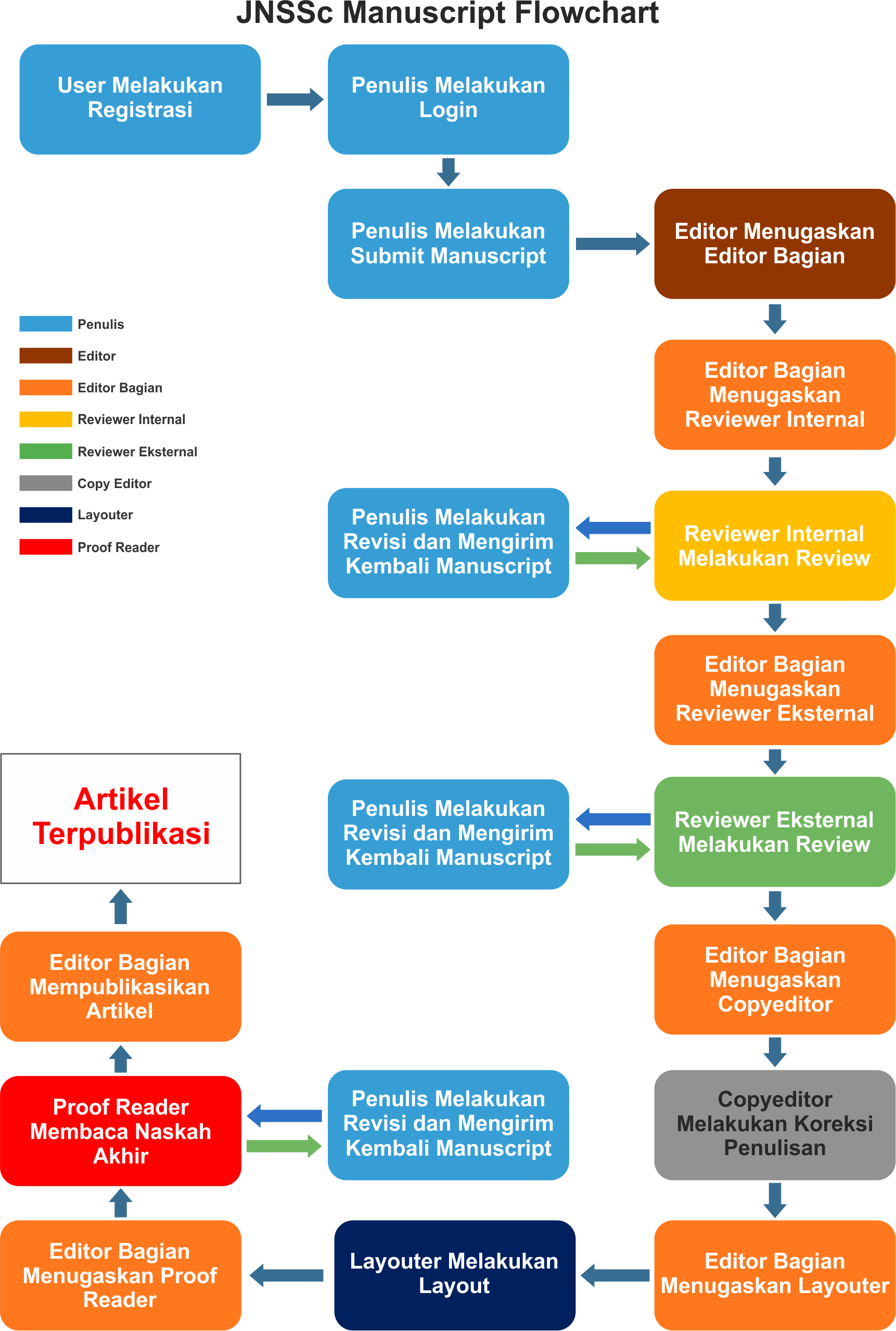

JNSSc submission flow